
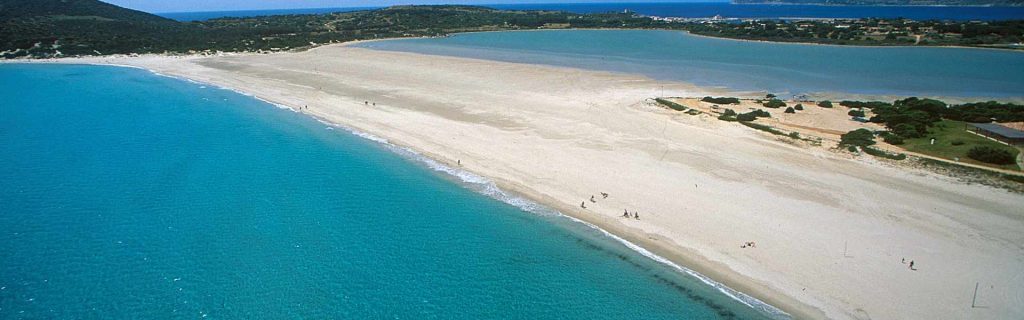
The Capo Carbonara Protected Marine Area, located in the south-eastern tip of Sardinia, is divided into two wide bays, one extending eastwards from the granite promontory of Capo Carbonara and the Isola dei Cavoli (eastern side) and the other extending westwards (western side). In this stretch of coastline one recognises coastal cliffs, sandy shores, wetlands and reforested environments. The diversity of the coastline is essentially determined by wave motion that incessantly and together with the wind exerts an erosive, smoothing action. The wind, a well-known characteristic of the area, together with the sea and seasonal watercourses transport sediments, feeding the coastline with precious 'sands'.
An alternation of small and large beaches set between the rocky promontories that are the seaward continuation of the rocky ridges belonging to the Serpeddì - Sette Fratelli granite massif (historical-geographical region of Sarrabus). It is to the incessant and cyclical process of demolition of the rocky substrata, fuelled by the wind and the energy of the masses of water (the waves), that the presence of the white beaches must be linked. It is an incessant and complex cycle based on two opposing forces: 'demolition and reconstruction', in which the Posidonia oceanica that beaches forms mounds called 'banquettes'. This cycle performs the fundamental function of dampening and regulating the distribution of sand between the emerged and submerged beach, retaining it and then releasing it naturally. It is to this function of dampening or dissipating the energy of the sea, performed by Posidonia, that we owe the presence of the beaches that are the main economic value of Villasimius but also the symbol of the naturalistic excellence of the Protected Marine Area.
The beaches of Villasimius generate sensations of great aesthetic appeal and from a naturalistic point of view, they are the result of primordial dynamic balances between sediments of terrestrial origin and those of marine origin in close relation to the Mediterranean climate in general and the local climate in particular.
Observing the different beaches, one grasps the extraordinary diversity of the landscape picture that from many points of view and perspectives, the collective imagination describes as beautiful, suggestive, spectacular, fantastic. Their originality is the result of very ancient, complex and unique natural phenomena (climatic, geological and biological) and less ancient anthropic phenomena (quarries, towers, etc.). These are unrepeatable, unique episodes with a Mediterranean character whose features must be safeguarded because they are everyone's heritage, today and for a long time to come.
Porto Sa Ruxi
The beach is immersed in a typical Mediterranean scenery, nestled between cliffs and characterised by white sand dunes secured by centuries-old junipers (Juniperus spp.). This environment 'Coastal dunes with Juniperus spp.', which is of priority interest under provisions such as the Habitats Directive 92/43/EEC, has a high environmental value as it is the identity of the undegraded Mediterranean scrubland and for which conservation actions are in place.
Campus
A beach located on the western slope of the Protected Marine Area, overlooked by the Phoenician site of Cuccureddus where the Rio Foxi flows with a wide mouth, reminding us that the Phoenicians also chose to settle for their trade in this area.
Campulongu
The beach is characterised by a long arc of fine, light-coloured sand, 1 km long, interspersed with enchanting granite cliffs to the south and small pebble coves to the north, located west of the Capo Carbonara promontory. Behind the beach, there are dunes interspersed with Mediterranean scrub, and further inland a large pine forest.
Old Fortress
Near the small harbour of Villasimius, there is this small beach that takes its name from the Spanish fortress of 1572 that overlooks the beach also called Torre Vecchia, a fortification overlooking the sea, a sign of a surveillance system that together with the tower of Porto Giunco and that of Capo Boi characterised this stretch of coast in order to defend the territory from pirate raids. The beach is in the shape of a crescent set among the typical Villasimius granites shaped by the sea and the wind. The sea is almost always calm as it is well protected by the promontory that houses the fortress, and the seabed of the bay that alternates between Posidonia oceanica prairies, sand and rocky seabed, make this beach an idyllic place for snorkelling and admiring marine life.
This beach has been defined as an 'ecological beach' in that environmental protection is favoured by choosing not to remove the leaves of Posidonia oceanica, which naturally fall from the plant and arrive on the beach following sea storms, but allowing the sea and wind to naturally manage its rhythms, without any human intervention. In addition, during the summer period, an awareness-raising campaign on the value of Posidonia banquettes and meadows is carried out on the beach, aimed at all beach users and schools.
Usai Quarry
Located on the eastern slope of Capo Carbonara, it is characterised by the presence of the imposing disused former granite quarry (Sa Cava Manna). The granite from this quarry was used to construct buildings and works but was also exported. There are sands (from the erosion of the granite), stones now polished by the waves and the wind, together with rocky outcrops.
Porto Giunco
The path to the beach runs along the Notteri pond behind the beach, chosen as a habitat by pink flamingos and other migratory birds.
A sandy tongue separates the two bodies of water, the sea and the Notteri pond, also giving this beach the nickname 'of the two seas'. It is an excellent example of a transitional ecosystem because this tongue of sand divides the pond from the sea. Porto Giunco is bordered by dunes covered with junipers, mastic trees and Mediterranean scrub. From the car park, there is a sendiero to climb the promontory to the southwest, at the top of which stands the imposing nine-metre-high tower of Porto Giunco, a 17th-century 'memory' erected by the Spanish of pirate attacks from the sea. From up there you will enjoy a dazzling 'picture'.
Simius
This beach is the continuation of the immense Porto Giunco. At 1 km long, it is the main beach that gives Villasimius its name, accessed directly from the centre of the town along Via del Mare. White sands and crystal clear waters make it one of the most popular and popular beaches.
Punta is Molentis At the mouth of the Rio Trottu, it is characterised by the presence of a disused granite quarry. The name of the beach derives from 'su molentu', i.e. 'the donkey', which was the vehicle used to transport the material extracted from the nearby granite quarry. The peculiar half-moon or arched shape of the beach, seems to join two strips of land, which make the beach rather sheltered from the winds. On one side it is enclosed by a low promontory that thins into a cliff, on the other side it is a mass of hollow rocks together with dense Mediterranean scrub.
A small and very special beach, since 2019 there has been a closed number for access during the high season. This restrictive measure was put in place to safeguard the area's ecosystem from an excessive influx of tourists.